The Conquering of Love

Nazareth was a planet, like all other planets, floating alone in the vastness of space, giving allegiance to a warming nearby star. It was far from all other occupied planets as all planets are far from other inhabited worlds. However, far distances were no longer much of a barrier to trade, tourism, and social sharing. So, Nazareth participated fully in the intergalactic federations of its time and grew rich and sophisticated. It shared in the technology developed by a million Babbages and Turins based on the science of a million Einsteins, Feynmans, and Gell-Mans. But it was, nevertheless, a strange world.

The first colonists had named it after a village on a distant planet, whose mayor they were told was named, Love. Some believed that this was not his true name but an honorific title bestowed on him. Some said that it was his true name because his father was also called Love. Anyhow, the long trip through space had generated many conflicts between the settlers and on landing they all decided that they should try to get along and so named their planet after the quality they all hoped would characterize their living together.

It was a good idea. Unfortunately it did not work out very well. As their population grew their conflicts grew. As they spread out over the surface of the planet, so their differences magnified. The families grew into clans, which joined into tribes, which joined into nations. Nations being what they are, fought with other nations. And so the millennia passed.

Two millennia ago, a strong genealogical movement arose. This movement spread over the whole planet. At first it was just a matter of tracking the family names, but then they tracked through their literature, their art, their technology, and finally their genetic patterns. It lead them back to a few small family groups who had braved the vast distances of space to find a new home, and the meaning of their planet’s name was rediscovered. They realized that their original fathers had wanted them to live the good life and that they measured the good life by love.

So people in every nation, in every culture, in every city and almost in every family, began to discuss what they had lost. It became a ground swell of goodwill. It was not an adolescent emotion sweeping through nations sickened by war. It was growing question in the minds of mature people, living on a sophisticated planet with the means to satisfy almost all human needs. Why can we not live together in peace? Why can we not love one another? We are, after all, one group of settlers who came to live together on this planet. Did we come to fight and kill each other? Did we come to achieve dominance over the other? No. Did we come to live together in a community, to help one another, to be a strength for each other, to share in each other’s good fortune and to help each other in times on hardship? Yes. We did not evolve from some common ancestor. We came here to live together in peaceful co-operation. Why did we forget? And so they remembered – they remembered their original values.

This ground swell movement covered the planet. Love was in the air. People became invigorated.  Bridges were built between neighbours, between cultures, between nations. There seemed to be great promise of something wonderful happening. Many great things did happen. People joined together in social activities, participated in many more business ventures, co-operated militarily, created transnational organizations for social justice, for the care of the downtrodden, the sick, the environment, and created art and music together. It was a wonderful decade. But it ended.

It did not collapse in one fell swoop. It broke down little by little. Petty differences became petty squabbles, became significant differences and lead to the break-up of relationships, groups and organizations. The differences became dislikes, the dislikes became hatreds, and the hatreds became conflict. The grand experiment ended.

Well almost. The Genealogy Institute remained. They analyzed the Grand Experiment, which was now capitalized. After about 5 years of talking and researching, they concluded that the problem had been that they had focused on the wrong emotion. They had tried to facilitate love, but they realized you cannot force people to love that which they see as foreign, alien, threatening, and hateful. Love occurs naturally when you see that which is worthy of love. They needed to find a way to reduce hatred. If peace, co-operation, love are natural states, then dislike and hatred are unnatural states. If love is not a natural state, then there will always be conflict that will have to be controlled by might and law. The philosophers, sociologists, psychologists amassed data and opinions supporting both sides of the argument. The Genealogy Institute eventually concluded that there was no unequivocal answer to the question and so decided, as they were practical people and, therefore, much enamoured with Occam’s razor (the simple solution is the correct one) decided to accept that love is the natural state of people.

The solution, therefore, was to find a way to end hatred. Thus began the Second Grand Experiment, which was capitalized right from the beginning. So they set the task to neurologists, psychologists, and sociologists, as well as the holy men and woman of their world. Identify what hatred is, where it comes from, and how it can be eradicated. It took them 10 years. Not a long time really. They did all that was asked of them. This is what they found.

Hatred, it seems, comes from a judgment people make about something, someone, or some situation that causes a painful disequilibrium that, it is believed, can be relieved to some degree or other by an attack on the thing, person, or situation causing the disequilibrium. The consequence of this judgment is the emotion called hatred. And hatred is just an extreme of an associated group of feelings ranging from irritation and dislike to full-fledged hatred. Some people’s brains were biased in this direction, some minds were trained to think like this, and some social situations tended to elicit these judgments. They discussed these things for those 10 years and slowly developed a multitude of ways of dealing with it, of eradicating it.

They taught everyone the nature of hatred. How destructive it is to all states of life – physical, personal, and social. They showed all the evidence, gave all the background philosophy, explicated the psychological twists and turns of the mental processes, and showed the impact of it on their social life. In the end it was overkill. Very few people did not already know how destructive it was. No-one really enjoyed it and hardly anyone thought it had real value. Except for one situation and that had to be explained and changed. That situation was War.

War is fought in anger not in a state of goodwill. Their models of fighting all praised anger and hatred. Soldiers were thought to be better soldiers if they hated the enemy; how else could they risk their own death if they did not think it was to destroy a hateful enemy. So wars were thought to be best fought if soldiers thought in black and white modes; and the enemy was definitely the black.

This was a difficult thinking mode to settle, after all, all the generals thought like that, and although they tried to say that they fought in a civilized fashion (not like the enemy), after the propaganda settled, every war revealed the terrible atrocities the “civilized” allies had perpetrated. And all the soldiers said they were following orders, and all the generals denied they had ever told their troops to behave like that. And they were all telling the truth, those behaviours were just the natural consequence of hating the enemy, because armaments and capture allow opportunity for haters to relieve their painful disequilibrium by an attack on the enemy. The more vulnerable the enemy the easier it is to attack them, so in the field women and children and in capture, prisoners, are the most likely to be abused. If you understand your enemy, know the social and economic circumstances that drive them to attack you, it is very difficult to fight with the passion of anger, or to abuse them when they are in your power. It is even hard to fight them in the first place. So politicians and generals were the least supportive of the eradication of hatred.

However, the matter resolved itself with a strange twist. Studies showed that soldiers were more effective killing machines if they were not angry. They made better decisions, whether it was the generals making large battle plans or the troops fighting hand-to-hand. If they were not angry, they used their wits, were much braver because they were willing to lay down their lives for their comrades through a reasoned commitment and not through the heated passion of the moment, and had more endurance because they took better care of themselves. And so they fought with a sense of respect for their enemy; this gradually changed into an awareness that the enemy had reason to fight them or that it was only some false rationalization by a politician that was driving the war. Soldiers, being sensible people, slowly realized that they were being asked to kill other good people for silly reasons. So they started demanding that their leaders discuss things more, admit bad things done to others, make reparations, and make compromises. The result was that wars became less and less frequent. The military became world experts at non-military, conflict resolution. They used all their military efficiency and trained millions in the use of rational appraisal of circumstances, of controlling physiological arousal in arguments, of using rational thinking to settle rising anger in disputation, and in the philosophy of the win-win argument. The groups that were the perpetrators of the greatest amount of mayhem and killing – the armies – became the greatest peacemakers.

The Second Grand Experiment became a vast social movement involving teachers, preachers, philosophers, filmmakers, advertisers, in fact pretty well everyone became involved. It was so universally recognized as a prime value that the vast majority began to practice it. Hatred was called “the disease of humans”.  Violence in films and in sports changed. In films it was now portrayed as a weakness of character and the long-term negative consequences were usually indicated in the film. It changed within a few years from being seen as a heroic solution undertaken by an oppressed character to being seen as a poor short-term solution by people who did not understand things well. There were originally still plenty of fights in films but always undertaken in extreme situations and only as a control solution. They were not shown as the final solution of anything. The fixing of relationships and the setting up of mature, long-term communication processes were shown to be the truly heroic choice and the real final solution. As wars became rarer, as errors of behaviour, and as arguments ending in fights became less frequent, fights in movies slowly abated. They became rare and they were almost always attributed to someone with a serious mental aberration.

The model for the general citizen was of a person who was first and foremost a human being, this was the primary group to which everyone belonged, all other groups were subsidiary to this. So one’s country, one’s social status, one’s economic status, one’s job, one’s education, one’s football team, one’s religious affiliation, all these were not part of one’s primary identity. They were all human, which meant that they understood that behind any affiliation, skin colour, badge of status, was a person who had generally the same aspirations as they did, valued the same things that they valued, tended to think in the same way they did, and generally reacted psychologically to life in the same way that they did. All-in-all they discovered and understood in real ways that under the covers we were all the same.            

In the general community the first thing that was noted was that violent crime declined, followed soon by general altercations going down; arguments with raised voices became rare, in the home spousal abuse disappeared, and fighting in the school-yard seldom occurred.

The quantum change seen was in interpersonal behaviour. People got on with each other. The community became very co-operative. Individuals became important. People’s feelings mattered. The expression of differences was encouraged because they brought character to the community. The richness of the variation in life became prized by all. The varying skill sets of people became a valued commodity. People still got fired, divorces still happened, contracts were still broken, and fights still occurred, but very rarely. Concern and understanding became the common approach to interpersonal and community living. Hatred had, to a large extent, been eliminated.

This made it a strange community to outsiders. They came there and could feel the interpersonal difference. No-one was obsequious, yet they felt considered and cared for all the time. Because people were interested in them, they became interested in the people and often began good friendships very quickly. Things still went wrong; Life’s irritations remained. The holiday makers from other worlds still complained loudly at times, but not for long. Problems were dealt with, with real concern for the tourist. No one ever shouted back at them. Their concerns were considered real, their disappointments were always acknowledged, and fixing the problem always seemed to be a pleasure. The tourist’s satisfaction when things were corrected seemed to bring the servers real satisfaction themselves. 

Love, however, did not happen.

What did happen was that as a society they became deeply caring towards each other. People looked after one another. They had fun together; they challenged each other to do better; work was a team affair, and the team took it as a matter of pride that their work was well done. People were not seriously concerned when something did not work out. They took failure as an opportunity to learn something more. They did not make quick judgements as to what went wrong, even if the source of the failure seemed obvious. They knew that everything had multiple causes; that every person’s behaviour had multiple causes; that social situations elicit certain behaviours; that mental states by the judgments they make can hide and reveal different truths; that biological drives can promote strong tendencies, that are difficult to control, to behave in certain ways.

So they became very tolerant. They promoted social models of co-operative behaviour. They began spontaneously to practice a voluntary form of eugenics. Those who habitually were angry or filled with hatred were not considered good marriage prospects. They were not seen as partners for a good life. So they had fewer children and the biology of hatred was slowly washed out of the Nazarene community. 

A more and more sophisticated understanding of the mental mechanics of hatred developed. The community taught itself how to combat these thoughts. Different groups did it in different ways. The army used mental discipline techniques combined with disengagement from the situation, calisthenics, and the adherence to a rigid code of conduct emphasizing protection of others. Religious people used prayer and meditation and the liberal use of worry beads, now called love beads. Psychologists taught rational thinking, correct breathing and muscle relaxation. Businessmen taught win-win business strategies and published a famous book called The Art of Success. Advertisers played a big role in promoting the Second Grand Experiment. Very large prizes were offered in competitions for the best advertisements promoting what had come to be called the Nazarene Way, or Nazway for short.

Nazway was taught as a way of power, not one for the wimp. It required dedication, a commitment extending over years, and a willingness to practice every day. The payoff was huge. Their society changed within one generation. Even though they had only focused on one negative factor in their society, the ramifications of changing that were profound and extensive. Almost every interpersonal action changed. People changed, life vibrated, fear declined, anxiety was eliminated, confidence abounded, and all sorts of criminal activities completely disappeared. The huge problems that beset humanity, the regional droughts, floods, and other natural catastrophes were more easily dealt with, because mobilizing international aid was simple. Countries were very co-operative. Decisions could be made in a short meeting. Aid flowed out. Countries did not wait to see how much others would give, they immediately gave what they could. Co-operation extended into all social areas, business, health, science, the arts. The world became a better place.

Love, however, did not happen.

It had been thought that once the unnatural, hatred, had been eradicated, then love, the natural state, would naturally transpire. It did not. Although living was much better, and there was peace and caring between people, love did not blossom. The Nazway had created a great society, the Second Grand Experiment was by almost all parameters a great success, but in its ultimate goal it failed. Love did not happen.

What had happened? What went wrong with their thinking? They had spent three generations on the Second Grand Experiment. Their lives had improved immeasurably but Nazareth was not the place they wanted it to be. They knew they were much closer than they had been. They knew that few states, let alone worlds had done what they had managed. All nations had a history of a golden age, when citizens were in harmony with each other and in which peace abounded. There was no report in modern times of a place such as Nazareth. But in all the happiness they felt and lived out day-to-day, they all felt an emptiness behind it all. It was as if they partially glimpsed something else, something they knew was much greater, and something they knew they did not have. This longing, once awakened, became an anguish. A hush descended over the world. They waited.

The Geni, as the Genealogical Institute was known colloquially, went back to work on this problem. The scientists, religious teachers, the mystics, the artists, and all the other groups started working on this problem. They held world-wide conferences to pool their data. Ideas, information, hunches, revelations all flowed hither and thither. They slowly developed an idea of what was wrong and the Third Grand Experiment began.

They realized that good feelings and good behaviour have the same multiple causes as the bad ones do. They had just shifted from one set of elicited behaviours to another. The pendulum had just swung from one side to the other. Their society was better for it, they were individually better for it, peace, co-operation, and respect were better than war, chaotic behaviour, and hatred, but they were still experiencing a world controlled by the things of the world. It turned out, not surprisingly, that they were still subject to the universe they were in. They were in the world and part of the world. Love, it seemed, being the truth, the natural way, was one thing, not part of this dual and multifaceted world. It was by its nature whole, spontaneous, primary. It was not the result of input from the world. It existed beyond biology, beyond society, and beyond the structures of the mind. They had called this happiness and deep caring for others, love. They thought that is what they meant by the word. Not the overwhelming passion of romantic love, but the deep abiding feeling of concern for the other. This, they thought, was love. And they had found that. Of all known living creatures, they were the only ones who, in this present day had attained that. But it was not enough. And, they realized, that it was not this love that they were seeking. They wanted more.

Most people had glimpsed the transformative power of moments of tremendous love. They would do anything for the one they loved. And it was not a labour. They would do it as they would do it for themselves, no, even more, for in these moments they did not feel the presence of themselves, they only felt the presence of the other. They lost themselves.

This seemed to be the secret. All these biological, social, and psychological forces were rooted in the self. Without that these forces would just be playing with themselves. The person would be other; still involved, still active, but different. They were not sure what this difference would be but they felt increasingly sure that that difference is what they had been looking for. What they had is what they had wanted initially, but the journey had changed them. They needed to conquer this love that they had found, and reach out to embrace the next. And they developed a way to do this.

They realized that within the self-transcending reformative nature of the love they felt for the significant other was a way forwards for them all. They decided to strive to love all things in the universe. Not in a romantic way, not in the deep caring way one loves ones family, not in the wonderful love the child receives from the mother, who gives in a way that no man can, gives life and nurturance from her very body, but in the way the soul loves when the self is swept away and the two become one. And this they did, in a mere hundred generations.

They finally understood why it was said of the mayor of Nazareth, that small village on that distant planet so many years ago that he had paid all the debts of all the people living there, he had performed some atonement that had wiped their debts away. They realized that what he had probably brought was not great riches to pay for their debts, but had brought them a technique of at-one-ment that freed them to love all things.

People seldom visit Nazareth now. What used to be the most popular tourist destination in the east wing of the universe, now is only the destination of an occasional visitor. Usually a seeker and most often they would never leave. It is said that whereas visitors felt so welcomed in the past, that they were so special, now the experience is very discomforting. Everyone is just as caring, just as considerate, but stay for a week and things become very strange. You stop feeling like yourself. You have thoughts and emotions that seem to float through you seemingly disconnected from you. You start finding simple, silly things, very interesting, and just being there is enough, even if you do not do much. If you don’t get out soon, you are likely to buy a house and stay forever. If do get out in time, it can take some weeks for you to start feeling like your old self again. So people don’t visit much. The Nazway is spoken of in hushed tones. It is thought that it is some old-style magical system, possibly even an old surviving witchcraft practice. If you don’t want to become brainwashed do not go there.

But over the last few hundred years, Nazarenes have been leaving and going to other planets often millions of light years away, and living there for a few decades before returning. In each place a little colony of Nazarenes start practicing the Nazway. They often call their village, Nazareth. The people about them usually do not understand what they are doing and often demonize or divinise the original Nazarene. They remember, though often indistinctly, the teachings, something about loving the divine, loving others even your enemies, but they often forget the hard practices that people need to undertake to defeat hatred, conquer love, and find their home. But what they do remember is that there are people who have done that and, if they want to become greater than themselves, they too can do it.

And, just that, is a start.  
What Species is the Head of this Whole Life Thing

It has always been hard to describe the beginning. Perhaps there was just a ripple. Not in any particular thing; just in what is. Perhaps it was no big deal but there was No moment, then there was. And quite a moment it was.

It was really a delicious little moment by all accounts. It did not stay little for any length of time. It quickly expanded into a fairly substantial bit of real estate then it spawned off a whole lot of tiny, squiggly things, which flew around for awhile and then snuggled up with a few friends forming tiny neighbourhoods. These neighbourhoods soon linked up with others nearby and soon whole chains of neighbourhoods were busy interacting with other chains of neighbourhoods and so the matter of matter began. All of it starting with this very singular of events. It was something that started from simple beginnings but developed into a fairly complicated situation by the end of it all.

All in all, after a fair bit of time, about 13.7 billion years, give or take a million or two, the whole situation had settled into a pretty good rhythm. One species had achieved a fair bit of dominance over all the others and thought pretty highly of itself. In one of the last bits of old jungle left which was located on the west side of Africa, about 200 hundred kilometres inland from where the bulgy part of the head meets the thinner face part of the continent, an interesting debate began between the species living there.

Somehow a dispute had arisen over who was the head of the whole life-thing. This was a rather odd dispute because it was generally accepted that the lion was king of the beasts, and as such should really be the king of the whole kit and caboodle. However, there were dissenters. Deep psychological analysis in later years performed by wizened old men in ivory towers, led to the conclusion that the matter really had to do with identity. The “Who am I question?” reformulated as “What is my place in the whole show” and presented as “What am I worth?” and “Who is the judge of this?”.

These are the universal questions of life that everyone has to answer before you get out of bed in the morning. If you answer them badly, your day is usually terrible, if you answer them vaguely, then your day is rather miserable. There is a constant push to get affirmation and it sets off a day generally full of rejection (imagined, implied, or real), and recriminations plus a fair modicum of gripes, complaints, and frequent sucking up to authority figures. All in all, the sort of day you really would like to bequeath to the half-a-dozen narcissists you know. Of course, narcissists are precisely the people who answer these questions badly in the first place and this sets them off on totally unsatisfactory day of establishing their self-worth by loud proclamation to all and sundry. All and sundry, of course, are usually not much moved by loud proclamations and so the narcissists are forced into making more frequent and even louder proclamations, which are usually even less well received by all and sundry. So the narcissists go home bereft of satisfying warm fuzzies from their fellows, wrapped only in the cold covering of their own cries of self-worth.

Most species are not richly endowed with narcissists (maybe 4-5%), which brings us back to the King of the Beasts. He is a bit of a preener, lying in the shade of the acacia tree, waiting for his women to invite him over to the meal they have just caught. His day is full of sleeping, stretching, yawning, punctuated by an occasional roar to remind everyone he is still there and still the king. But, as I mentioned, there were dissenters.

Most of the trouble was fomented by a chimpanzee. He was a bit of an outsider as a child. When he grew into an adult, he became a gadfly in chimp society. Always asking odd questions. As the years went by these questions started seeping into chimp society and then began spilling over into other species in the community. This led to the growing disquiet in the Jungle, which finally spilled over into the debate in question. It was felt that someone must have the answer to these questions. Surely, the king’s answer will be the correct one. So, who is the king? The chimpanzee volunteered that perhaps the king to ask is the king of the top species. Living in a survival community, this seemed to be a very reasonable position to take. Little did they know that the chimp was up to his usual mischief and that this suggestion was going to change their whole world.

However, it seemed innocent enough, so they set to with the type of enthusiasm, only available to hunter-gatherer communities, who know that the feast at the end of the successful hunt it worth all the risks and dangers of the hunt. In the tops of the trees, around waterholes, on the open grasslands at the edge of the jungle, they discussed it.

In the beginning every species had a belief that they really were the important species. After all everyone knew most about their own lives. They knew about their values, which were good, life-positive, and promotive of their wellbeing and that of their community. It was this latter clause that caused all the trouble. At first they did not see that it was a problem. It was the chimp who messed the nice picture up. He went from place to place all over the jungle just asking one question – “Why is the community relevant to your importance?”

“What a silly question” said the monkeys, which was quite something coming from the silliest creatures in the jungle. “Isn’t it obvious”, said the vultures, which raised many eyebrows, as even a vulture mealtime raises serious doubts about any sense of stable community in vulture society. “Umm” said the impala, who thought that the question needed no explanation, but were struggling a bit with the idea of being separate creatures from the herd. The ants and the bees were silent. They did not understand the question. They were the community. The trees knew the answer; they were singular and multiple. They sighed their support for the chimp. They knew what he was doing, to what he was guiding the species. They did what they could to make his travel as easy as possible from one side of the jungle to the other.

As the creatures thought about this, two shifts occurred in their thinking. The first was the realization that their community, their species, is really what gave them meaning, provided them with pleasure, challenge, food, security, affirmation, and that beyond the community there really did not seem to be any understandable value system of merit. Every different understanding of God that different species worshipped, honoured, or rebelled against, presented an ethical system that was rooted in love of others, doing good to others, and taking care of others. As singular creatures individuated out from the group, their responsibilities to the group became less an innate drive, but more powerful as an ethical principle. It was as if life knew that promoting individuation risked existential death if community contact was completely severed, but knew that it was worthwhile for the greatest happiness that can be experienced comes from reconnecting, with one’s full independent consciousness, to the community and losing one’s self in contemplating, caring, or loving others. The community exists as the one significant other who is next to you who needs your loving and responds best to that among all the things you are able to share. The challenge as an individuated entity is to recognize that the sharing means knowing how to give in a way that is understandable to the other, not just in way understandable to you. The only way to do this is to become aware of the internal state of the other. To feel as the other feels, to know the other’s mind, moods, needs.

This first shift caused real problems. The lion started thinking about the lioness’s life. He started to occasionally let his lionesses have the first bites of the kill. He thought they had worked harder for it than he had. They were, at first, seriously nonplussed by this change in traditional behaviour and thought that perhaps he was losing his potency and needed replacing. Certain subsequent behaviours, which shall not be mentioned at this time, quickly disabused them of those notions, so they felt very affirmed by his largesse and went ahead and took the first bites. However, they began to wonder why he was doing this. They began to think about his needs, about the difficulties of his life, what he did for them. They began to think that really he should have the first bite. This led to a number of rather unfortunately acrimonious altercations over who was going to let the other eat first. Finally they worked it out and so at times the one went first, at times the other and at other times they started together. All through the species in the jungle there were ripples of change in behaviour. New patterns were worked out. New joys and new challenges emerged. The societies began to change.

The second shift should have been foreseen from the first one. Perhaps those wizened old psychologists did see it coming, but it was probably too late to prevent the destruction of life.

It was at one of the big debates at the Giant Oak Waterhole, which was the largest waterhole in the whole jungle, that the matter came to a head. The lion was arguing that that lions were the top species because he was the King of the Beasts. He could kill any other animal. He was the most powerful. Lions held the preeminent position in the killing hierarchy. Every other meat-providing species feared the lion. They were the best species. The dissenters pointed out that all species killed, being a bigger killer was not such a great deal. It was just a matter of size. By body weight hunting dogs killed more than lions, so did jungle rats and bats. And bats killed while flying at great speed and performing amazing feats of location and flying dexterity; the lion merely hunted in a pack, isolated a prey and tore it down by mass of numbers. So by amounts killed and skill, lions are pretty low on the hierarchy. This rather mollified the lion, but he could see their points. Various other species made their claims, but none gained much acceptance, until the chimpanzee asked about the primary producers, the trees and the grasses.

All species eventually came to accept this proposition, that the trees and grasses were the top species. A few species posited homo sapiens citing the amazing things they had seen the jungle tribes do. However, this did not last long. It was apparent that they were a very misguided type of species and clearly did more harm that good in their own group and to the jungle that surrounded them, let alone the suspicious relationship they had to the roaring metal monsters that were busy destroying the jungle on its periphery. It seemed obvious that they had a cheek calling themselves “sapiens” or “the wise”. They had a lot to learn about life that was common knowledge amongst the other jungle denizens. No, the plants won hands down.

They won because all the other species realized that they were our transformers. They changed the star energy into something we can use on the earth. That energy was the only energy that living processes could use (the news of deep sea vent life had not reached this far into the jungle as yet). The plants gave life to all the other living entities on the planet. They did this selflessly, without moaning or groaning, day and night (although much less at night), in good weather and foul. They wrapped this energy up in their bodies and then offered them to all the species of the earth. All other species eventually accepted this conclusion. These were the primary species and they revealed a startling truth. All life is connected. The powerhouse of energy production took the energy of the sun added it to nitrogen and other elements derived mostly from the soil and formed sugars and starches. These were then given to animals who converted them into proteins and fats. The animals died, and some acknowledgement was given to the lions for this to assuage the pain from having lost their elevated position as top species, and so their flesh was returned to the soil, where the microbes broke it down and freed up the nitrogen for the plants to use. So the cycle was complete. The plants were our connection to the stars. They are the only entrance to our energy-needy, earth life-systems. So, the plants revealed that our true community lies beyond our own species.

The first shift revealed how to behave towards our community and the reason for doing this. The second shift revealed who constitutes our community.

So all species began to live more and more selfless lives. Even humans were finally dragged into this vision of things and this way of living together on the earth. Within a very short time, astronomically speaking, that is in only a few million years, all species connected to each other and become one. The universe transformed and in blink disappeared back into what is, leaving barely a ripple.

It has always been hard to describe the beginning. Perhaps there was just a ripple. Not in any particular thing; just in what is. Perhaps it was no big deal but there was no moment, then there was. And quite a moment it was.

It was rather a delicious little moment by all accounts and it did not stay little for any length of time. But this creation was different. It did not begin as a singularity. It began as a complexity. It was conscious from the start. It knew right from wrong and it had the knowledge of life and death. Its challenges were of a different nature. But that is another story. Amen.

What is the question

She had been alive for quite a long time
She was just aware
There were colours that came and went
She was curious
But did not know what curiosity is
Nor what she was curious about
She just let things be what they are
And waited
Sure enough
Edges appeared
And things popped into existence
And place just popped into existence
Well that was certainly curious
She thought
And that was very curious
Because she did not know
What thinking is
It just appeared
Same as things just appeared

So she just watched
The thinking and the things
Some time later
It struck her
That she did not know
If things were there
Before she saw them
If thoughts were there
Before she thought them
And there was time
It just snuck up on her
There it was
The just now, the now, the to be now

One day she was walking along a path
And discovered that
She was walking along a path
She suddenly became aware
That she was aware
The world changed
It became full
Of herself and of other things
She saw them
And it was amazing
Before then she looked at everything
And they were
Part of a whole
Now when she looked
They were distinct things
She saw the world
For the first time

Now she saw
That things were happening
And she was there
And she could plan
And change
The behaviour of other things
She was part of the world

After a while the thought arose
Perhaps as I know I am seeing them
They are looking back and seeing me
Perhaps the same is in them as in me
It came to her that possibly
The world is full of minds
She pondered this
Then she thought maybe
Everything has a mind
The wind and the water
The mountain and the valley
The fruits and vegetables
The animals
People
My toes
I can control my toes
I can make them
Curl up, curl down
So perhaps some minds in the world
Can control other minds in the world
She decided that that
Was not unreasonable
Therefore there are
Big Minds and small minds
Big minds control
Floods and droughts
Light and dark
Injury and illness
Good fortune and bad
She called these minds gods
The small minds were those
That could only control
The other minds in their bodies
Animals and people had small minds

As time went by
She noticed that
She told herself stories
Lots of stories
Other people told stories
Lots of stories
She realized that
People are story tellers

She listened to stories for a long time
In time she discovered
That not all stories are true
So she embarked on a journey
To discover which ones are true

One day out in the forest
She came across a door
Just standing there
Upright and with a handle
There was a man sitting there
Cross-legged on the the ground
She was curious
She wanted to go through that door
She said to the old man
Can I go through that door
He looked up at her
Held up his hand
In two fingers he held a key
She stepped forward
He took the key away
He said
What is the question
She said I don’t know
He closed his eyes
She walked away
Nonplussed

So time went by
Yet the question always
Remained with her
She learnt many things
She learned about the world
From the largest things
To the smallest things
And things in-between
And she never came to a full understanding
Yet she never stopped seeking
But she felt unfulfilled
She learned about people and communities
She learned about individuals and groups
And she never came to a full understanding
Yet she never stopped seeking
But she felt unfulfilled
She learned about the mind
Its parts and their interactions
She learned about
Its consciousness and its unconsciousness
And she never came to a full understanding
Yet she never stopped seeking
But she felt unfulfilled

One day while she was deep in meditation
The answer came
And she felt a wonderful sense of fulfillment
The next morning on her walk through the forest
She came upon the door
The man still sat there
He watched her approach
She stopped in front of him
He looked no older
Than she remembered him
From years ago
He said to her
What is the question
She answered
I agree
Her smiled at her
And bowed his head
May I go through she asked
He gestured towards the door palm up
And bowed his head in respect
May I have the key she asked in a quiet voice
He said you have already unlocked it
She walked to the door
It opened at her touch
She turned back and said
It is a coin that has
What
On one side
And
Curiosity
On the other
It was never a question It was a statement
He replied it takes a long time to realize
That it is the journey and not the destination
That is living
She turned and walked through the door
And entered a flourishing life

There was a little girl

There was a little girl there before the dawn of time. She knew nothing because she knew everything. Everything was there, not because there was something, but because everything could be and, therefore, was, because everything that was possible, was possible and so it was there, in a strange sort of way.

We who came later, called this time, the Possible. The little girl’s name was Desire. So, before it all began, in the nothingness of everything, Desire did what she could, she desired a universe.

And there it was; it burst into time and space and eventually there was a little planet; the 4th one of a star in the outer arms of a fairly inconspicuous galaxy about 5 billion years out from the centre of the universe, and on that planet there was a little girl, who, being born, fell into love. She didn’t fall in love with something, she fell into love itself.

To her the world was radiant; all things glowing with love, each thing, when looked at, was breathlessly beautiful. She could feel all things in herself and feel herself in all things.

Yet, as time strengthened its presence, things separated; they attained their own status, manifested their own place in time; developed a history and a future. The world entered space and became separate. Objects became interesting.

Love for all subsided and objects became valued; love became attached; it became portioned and qualified. She learn’t this by experiencing pain and discomfort, pleasure and comfort; she slowly forgot the wholeness of all and learn’t the particulateness of things. Things became individual and received different values. She slowly forgot that she was Desire and desired all; she now felt different desire for different things. She was born into her own creation.

She learn’t the levels of love; that which she first experienced, that which first gave pleasure and succour, she loved the most – her mother and her father, then her greater family, then her group (her friends, colleagues, neighbours, town, country and all the other people to whom she affiliated herself), also her animals, other animals, her property and the whole of nature. She loved them all to a greater or lesser degree.

To those to whom she did not apportion some love, they became the unloved. They had no assigned value but could very easily become assigned different degrees of being unloved. They could become the disliked even the hated.

She had become almost completely disconnected from the love she fell into at her birth; she was almost completely disconnected from her sense of being at one with all. The merest flickers remained – she heard people saying God is Love and that seemed to have some meaning to her, but it was a vague concept with no felt reality.

So, she grew up loving her parents, loving her partner and her children, liking her friends, and feeling good about so many other things of life – her work, her property, her country, her beliefs, her goals. She did good things in life, she was a good person, she helped others selflessly, she cared for the downtrodden; she tried to make the world a better place.

Her life seemed full and rich to her. She was happy; she had completely forgotten her first experience of life, well, almost completely. There were times when she felt longings to go somewhere quiet. She loved to walk in the forest, along the beach, or to sit at the edge of the lake at sunrise or sunset. It created a deep feeling of peace in her; it touched some deep longing in her and seemed to remind her of something forgotten. It was not easy to stay there for long; she would eventually become uncomfortable and return to her world.

Her children grew up, her worked matured, her relationships deepened, her body aged, and she became unsatisfied with life and living. She took to writing her thoughts down, a book she kept well hidden from others; she started listening more to music, and she started watching life more and more as if it contained some secret that she had missed all along.

She was still there in life, living with others, doing her work, but inside, she was moving away. Her sense of ownership became vague, she had little attachment to her things, she could easily give anything away to someone who wanted or needed it. She became aware of people all over the world living lives just as she was here living a life. She felt more part of nature, more a living thing than a human being; she began to be concerned about things and people she never gave a moments thought to before. In some way, she felt lost and, in some way, she felt she was coming home.

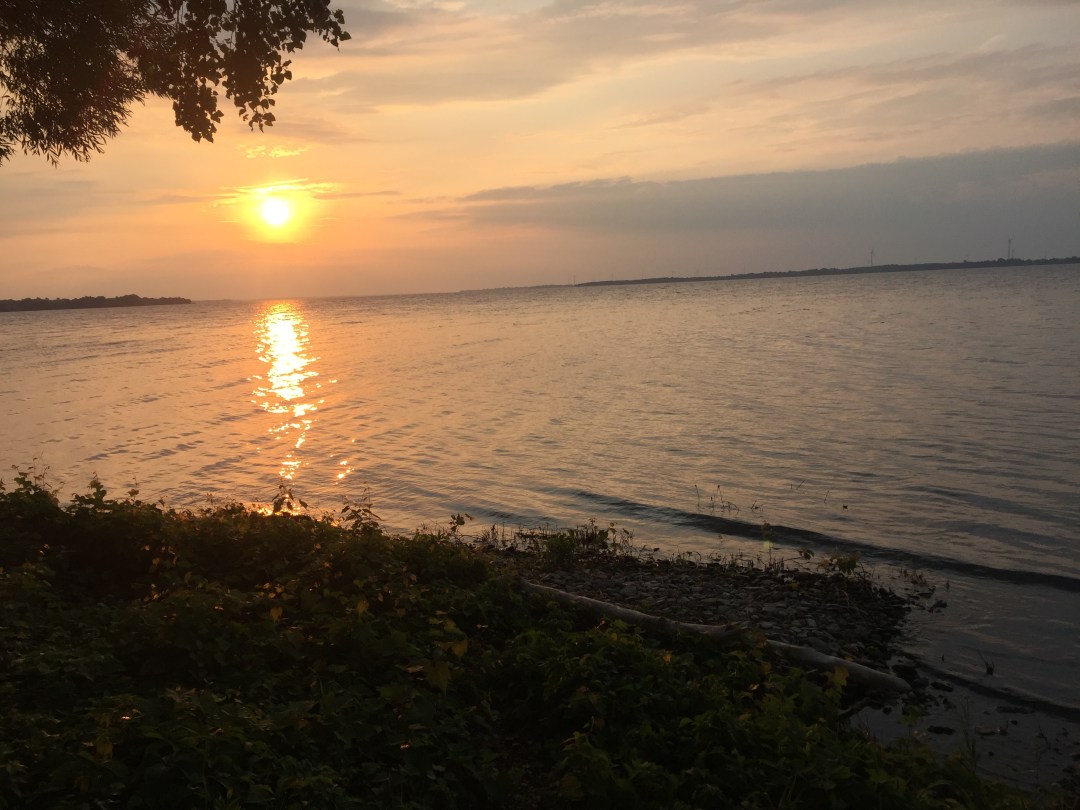
On day, she was walking by the lakeside with her family at sunset. She was quiet, very quiet. Her children and husband were talking. As the sun touched the horizon, its golden rays painted the clouds, at first with a golden glow, which changed to pink, then red as the sun sank. The air fell silent, no bird calls marking their return to their nests, no wind whispering through the trees, just a deep silence. The family stopped talking hushed by beauty. ………………   She was there as the sun started to sink below earth’s edge …………….. and then she was gone. She fell back into love and then she was Desire and she was pleased. She knew everything; everything was possible and yet everything was there. She hugged her children and holding her husband’s hand she walked off into a radiant world that she again could see was glowing with love.  

Walking at the Edge of the Day on the Banks of Lake Ontario

The world is always with us. So often though, it only exists on the periphery of our awareness. We live in it but with little acknowledgement of its presence. It impacts on us more when it fails us than when it provides for our needs. At sunset times, however, it calls to us, granting an opportunity to become intimately aware of its being there. If we stop and look, we may be pulled into a rich sense of its presence and of its intrinsic wonder. We may lapse into silence as our sense of self retreats into the background and we come face-to-face with the world. We are left standing breathless behind the huge majesty of this earthly moment; lost in the stillness of the transition as light leaves and darkness arrives. The world changes with no conflict only the gentleness of going and the quietness of coming; marking the gracefulness of the world’s rotating dance in front of the giver of life.     

My wife and I seek out these moments as often as we can. We love to go walking, hand-in-hand at the edge of the day on the banks of Lake Ontario searching for the stillness and finding intimacy with the world and intimacy between us. This time of wonder seems to facilitate a connection with the world but also opens pathways of intimacy flowing from one to the other. It seems that sunset allows the development of a rich intimacy that is harder to nurture and experience in other times of the passage of the day. 

Through the multitude of such walks, I have seen a pattern that often develops in our conversation. I do not know if it is from the nature of the experience of this time that pushes one’s self into the background; perhaps it just comes from disengaging from our life activities; perhaps it is from a longing to be close; but, with this gift, we go to stand before the silence of the setting sun, with nothing to do but experience being there.

I embrace this pattern of communication that we seem, so frequently, to follow as we walk through the golden hour.

We seem to start like this. We hold hands. It is very difficult to walk at sunset and not hold hands. It allows an opportunity to acknowledge the other even though no words are spoken for long moments. Holding hands allows the sharing of such silent moments without causing a breach in being together. We talk at first of the day gone by and the day to come. Perhaps initially of mishaps and difficulties, but soon, as such considerations seem incongruent in this golden hour and in this state of deepening intimacy, our words turn to our experience of what we see around us.

We often talk of the trees, of their presence, their sense of being here beyond the years of our life, how each is unique, even from the other members of their family living around them. We wonder whether, throughout the whole world, could there be another tree exactly like this one before us, and we smile as we sense how unlikely that is.  It is unique.  We are stilled by the recognition of its specialness, only made apparent by our stopping, in this time of quietude, and giving it our attention. We stand at its foot and feel the connection as one unique part of this world recognizes another unique part of this world.

We sense we are in a special place, made so, not by it being what it is, but by our recognizing it, and we hold our hands a little tighter, reflecting our sense of this greater intimacy.

We point out many things, the water’s dance over the rocks on its edge, the interesting branches, small and large, that having fallen into the lake have travelled here and been washed up onto these rocks, waiting to be carried off again to find a resting point at the lake’s bottom there to join back into the ground of this earth (some, of course, have found their way, mysteriously, back into our home and now nestle against some wall or on some table, sharing their charm with us and memories of how they called to us and we made them part of our family).

We also talk about other people we see there, the young, the middle-aged, and the old, and we wonder about their stories and we feel close to them as we are all here in this place at this time of beauty. We have all come to be here now, for one purpose, perhaps with different emotions, but as the sun sinks, we all turn to watch that one event together.

As the sun gets closer to the edge of the earth rising up to meet it, our talk turns to intimacy; to the intimacy that lies between us, to the pleasure we have had in living the past day as partners in this life, to the joy we have in each other, to our sense of the specialness of the other, to the wonder of being so privileged to share another’s life so deeply. Then as the sky darkens and the pinks become reds, we celebrate, in a growing, intimate silence, with our arms around each other, the wonder of being alive here in this conscious interlude, aware of being in and being a part of this great mystery of life.

And so, the sun is gone, and we walk back to the car in the fresh darkness of the early night, in deep peace from our walk and talk at the edge of the day along the banks of Lake Ontario.